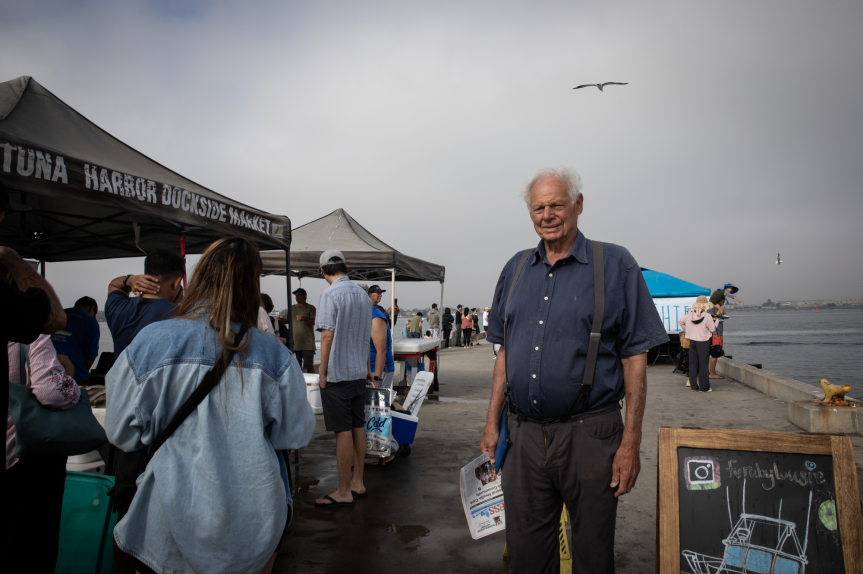
If you’ve strolled through the Tuna Harbor Dockside Market on a Saturday, you’ve likely seen me (tall guy, suspenders) and my son, who co-captains our sea urchin business. As a fisherman for 50-plus years, I spend market days connecting with fellow fishermen vendors and chatting up customers. Our bustling open-air market brings an abundant catch to the city’s doorstep: rockfish, swordfish, tuna, mackerel and more.
Through ongoing outreach, our fishermen have reconnected with the heart of San Diego. Now nearly 1,000 people show up weekly for the chance to buy high-quality seafood from local fishermen. Demand has never been higher. But meeting that demand is a constant struggle that we can’t solve without infrastructure.
The $3.8 billion real estate project planned on top of our harbor has some funds earmarked for seafood infrastructure. But after six years of delays, negotiations are now extended to 2027 and our fishermen can’t wait. We need facilities now.
That’s why the Domestic Seafood Production Act is so crucial. The federal bill would earmark $90 million in funding for qualifying seafood infrastructure projects. The right funding would enable us to purchase facilities to preserve our catch, meet growing demand and reduce waste. Without it, we’ll keep losing opportunities and scrambling to stay afloat. With 2025 around the corner, we hope to secure support from local lawmakers to help move this bill across the finish line.
The Domestic Seafood Production Act would also protect marine resources by requiring congressional approval for U.S. agencies to fund offshore industrial aquaculture in federal waters. Here in Southern California, the National Oceanic and Atmospheric Administration has already proposed aquaculture zones near a radioactive DDT dump site. We don’t need disastrous fish farms competing with our fishermen; we need investments in our local economy that keep us fishing and feeding our neighbors.
Take our current challenges: When small-scale fishermen bring in their catch, they need a place to store, process and then deliver it. Without these facilities, we can end up with nowhere to preserve our catch. It’s a dead-end alley that prevents us from expanding our business.
Consider this: We’re proud to supply the San Diego Food Bank with fresh seafood weekly. Over the past two months, we’ve delivered them more than 3,500 pounds of nutritious fish. We always find a way, but it’s no small feat. We rely on MacGyver-like ingenuity to move fish to processors and deliver it to our clients. The Domestic Seafood Production Act could help us instead do what we do best: catch fish and feed communities.
The lack of infrastructure also creates waste. Right now, our fish waste that could be used as lobster bait or other valuable byproducts ends up discarded. With Domestic Seafood Production Act-funded facilities as soon as 2025 or 2026, we could make sure every part of the catch is preserved and used.
That’s where local restaurants come in, too. They’ve been eager to support San Diego’s fishermen but only need certain species on certain days. A cold storage facility would help us manage inventory and meet these demands. This could allow chefs to plan menus, use every part of the fish for creative dishes and cut waste.
Our San Diego Fishermen’s Working Group is already laying the groundwork for an apprenticeship program to attract the next generation of fishermen and combat a graying of the fleet. By investing in infrastructure, the Domestic Seafood Production Act would make this career path more accessible to young fishermen.
At its heart, this isn’t just about fishermen. It’s about preserving our city’s coastal heritage and connecting our diverse 3.3 million greater San Diegans to the bounty of our ocean. It’s about making sure that small-scale fishermen, who historically always get the fewest resources, have tools they need to thrive. And it’s about creating a durable local seafood economy.
At age 83, I’m still diving two to three days a week. I love what I do, but like me, many of us will be passing the torch soon. The Domestic Seafood Production Act could be a leap forward for our port’s fishing future.
Halmay is co-owner of the Tuna Harbor Dockside Market, and co-founder of the San Diego Fishermen’s Working Group and the Fishermen’s Marketing Association San Diego. He lives in Lakeside.


Leave A Comment